



On 5 December Beijing time, the Ministry of Education of China and the French Ministry of Higher Education, Research and Space jointly hosted the Second China-France Education Development Forum at Sichuan University in Chengdu, China. Minister of Education Huai Jinpeng and French Minister of Higher Education, Research and Space Jean-Baptiste attended the forum and delivered addresses. Shen Haitao, Deputy Party Secretary of East China University of Science and Technology, represented the institution at the forum. Ros-Noëlle Vannier, President of the French Federation of Chemical Engineering Schools (FGL), attended as an invited partner and delivered a presentation entitled ‘Building a Future-Oriented Talent Development System to Promote Sustainable Development’.
In her address, Ros-Noëlle Vannier highlighted the fruitful collaboration established between the FGL Alliance and East China University of Science and Technology. This partnership represents not merely an inter-institutional alliance, but a profound integration and innovative practice of two distinguished engineering education philosophies. The FGL Alliance expressed its willingness to join hands with ECUST to embark on a remarkable chapter of ‘complementary strengths, jointly shaping the future’.
In recent years, the collaboration between East China University of Science and Technology and the French FGL Alliance in engineering talent development has deepened significantly. In November 2025, President Hwan Bok-jin of East China University of Science and Technology visited France and signed a framework cooperation agreement with the FGL Alliance. This agreement aims to ensure the joint development of a high-level talent cultivation system featuring ‘dual degrees, dual cultures, and dual competencies’ between China and France. Through multidimensional integration encompassing faculty and student exchanges, joint curriculum development, and academic staff mobility, it will continuously advance collaborative development in scientific innovation and industrial practice. This initiative will not only significantly enhance the internationalisation and teaching quality of engineering education but also establish a stable and long-term Sino-French higher education cooperation platform, holding profound significance for promoting scientific, technological, and cultural exchanges between the two nations. Over the past year, fourteen French students have undertaken short- and long-term study and exchange programmes at the university. Through coursework, internships, practical training, and research projects in fields including chemical engineering, biology, business, and Chinese language, they have completed their academic plans. Students consistently report substantial gains in specialised knowledge, practical skills, and understanding of Chinese culture. Moving forward, the university will continue expanding international exchange channels and refining its training system to provide high-calibre international educational experiences for more overseas students.
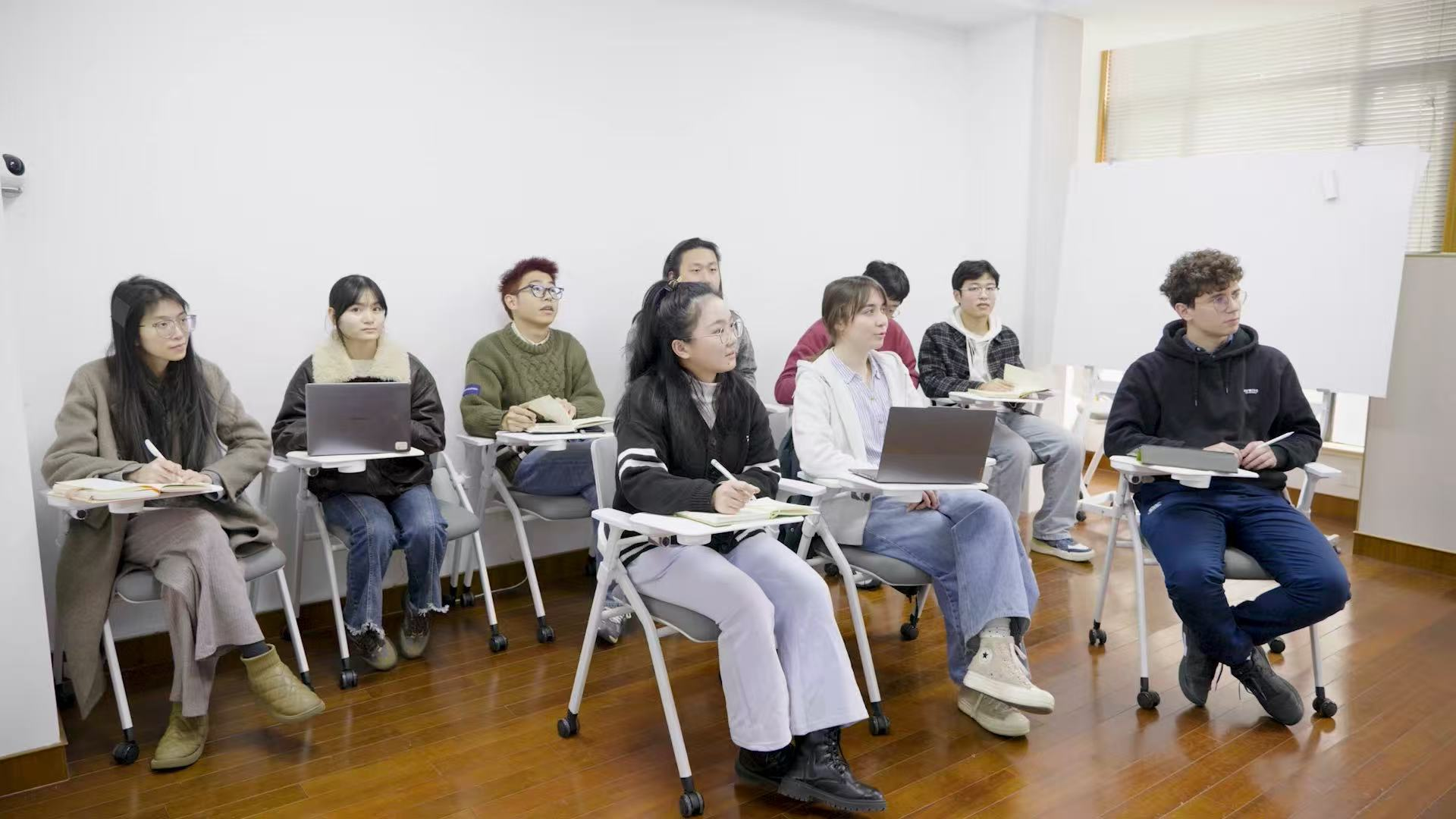
The International Elite Engineering school, established in 2019 through a joint venture with the FGL Alliance, has developed a mature Sino-French dual-integration educational system with substantial achievements. Its innovative educational model combines France's elite engineering education with China's undergraduate-master's framework, creating a dual-track, multi-exit pathway where students may pursue postgraduate studies domestically or undertake joint training in France. The School rigorously adheres to French CTI accreditation standards, incorporating over 70 French-developed foundational courses in mathematics, physics, and chemistry alongside engineering competency modules. It has further introduced specialised modules such as ‘AI+’, employing small-class project-based teaching to solidify educational quality. Regarding student recruitment, the School enhances intake quality through multiple channels including the National College Entrance Examination, Shanghai's Comprehensive Evaluation for University Admissions, and internal secondary selection processes. Admission thresholds consistently match or exceed the university's overall admission scores. Currently, the School has assembled an international faculty team including seven French professors. Each year, the French side dispatches over 20 lecturers to teach in China, while the Chinese side selects more than 30 specialist lecturers to participate in teaching. Both sides regularly conduct teaching and research activities to promote the coordinated development of teaching and research. In industry-academia-research collaboration, the School partners with enterprises such as Arkema, Sessco, and Michelin to offer corporate-designed courses including ‘Chemical Process Modelling and Numerical Computation Methods’ and ‘Process Safety’. Centred on ‘industry-driven projects’, these programmes enhance students' practical capabilities. In May 2024, the School established the Industry-Education Integration Promotion Committee in partnership with 12 Fortune Global 500 enterprises to jointly develop industry-academia-research practice bases. These integration achievements have been featured in over 20 mainstream media outlets including the People's Daily and Guangming Daily. Regarding academic exchange, the School has welcomed six French students and plans to admit over ten more by 2026. For cultural exchange, initiatives like the Sino-French Cultural Festival and French Singing Competition foster a diverse atmosphere. In July 2025, a Summer School engaged 26 Chinese and French students in language learning and cultural immersion. Over its six-year operation, the college has graduated nearly 200 students, with 75 proceeding to further studies in France. Students have consistently excelled in competitions, including winning the Gold Award at the 2024 China International College Students Innovation Competition, demonstrating outstanding talent development outcomes and establishing a model for Sino-French higher education collaboration.
The Second Sino-French Education Forum and President Macron's state visit to China have resonated profoundly among students at the International School of Excellence in Engineering at East China University of Science and Technology. Zhang Jiaxin from the Guozhuo Applied Chemistry Elite Class 251 remarked that the educational cooperation consensus reached during President Macron's visit has injected new momentum into Sino-French exchanges, offering French exchange students more diverse programmes and optimised policies. Wu Junyi from the Elite Class 251 of the International Excellence Programme in Chemical Engineering observed that President Macron's ‘de-ceremonialised’ approach demonstrated cultural empathy between the two nations. As a student in this collaborative programme, she has personally experienced cultural integration through bilingual instruction and cross-cultural activities. Liu Chang from the Environmental Engineering Class 230 noted that Sino-French cooperation plans in aerospace and green economy directly address shared global challenges, inspiring her to deepen engineering innovation while aligning personal growth with national development. Zhou Yucheng from Class 230, Guozhuo Chemical Engineering, remarked that President Macron's statement that ‘young people are the future shapers of the world’ instilled in him a profound sense of mission. He emphasised that to continue the legacy of Sino-French educational cooperation, it is essential to strengthen professional foundations and enhance cross-cultural competencies to contribute wisdom to Sino-French friendship. The students unanimously agreed that the outcomes of the forum and the visit to China will propel the internationalisation of engineering education, helping them grow into outstanding engineers with a global perspective.